LANDER BLUE
 The
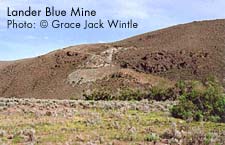
Lander Blue turquoise mine in Lander County,
Nevada is located between Battle Mountain and
Tenabo. Found in 1973 it produced some of the
most beautiful spider-webbed turquoise ever
discovered. Today it is considered the most
valuable turquoise known. Not surprisingly as
early as 1975 it had been stated that Lander
Blue “has become some of the most valued
turquoise today.” The
Lander Blue turquoise mine in Lander County,
Nevada is located between Battle Mountain and
Tenabo. Found in 1973 it produced some of the
most beautiful spider-webbed turquoise ever
discovered. Today it is considered the most
valuable turquoise known. Not surprisingly as
early as 1975 it had been stated that Lander
Blue “has become some of the most valued
turquoise today.”
Like a number of the other
high-grade strikes, Lander Blue was a very rich
pocket discovery, and has been referred to as
a “hat mine,” a term used to described
small floats of turquoise because they could
be “covered with a hat.” There were
no extensive zones or long veins. These pockets
are not uncommon in nature and once mined out
they are gone forever. Lander Blue is almost
entirely spider-webbed turquoise with colors
from medium to deep blue and a black contrasting
matrix. Although some other grades were found only approximately 100 pounds of the beautiful spider-web turquoise was mined.
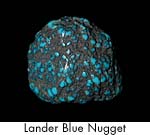 Like all classic turquoise this one comes with a classic story. RitaHapgood, a one time blackjack dealer in Battle Mountain, while walking with her two sisters found little nuggets on the ground along Indian Creek in the Crescent Valley area of Nevada. After discovering this deposit of high-grade turquoise she went on to claim the site as the Mary Louise Lode Mining Claim, the name Mary Louise belonging to her mother. The mine bordered the Lander Ranch. Later the claim was sold to Marvin Syme and Henry 'Hank' Dorian for the sum of $10,000.00. They brought in Bob Johnson, who provided equipment and began working the claim. The three then named the company the Lander Blue Turquoise Corporation. Like all classic turquoise this one comes with a classic story. RitaHapgood, a one time blackjack dealer in Battle Mountain, while walking with her two sisters found little nuggets on the ground along Indian Creek in the Crescent Valley area of Nevada. After discovering this deposit of high-grade turquoise she went on to claim the site as the Mary Louise Lode Mining Claim, the name Mary Louise belonging to her mother. The mine bordered the Lander Ranch. Later the claim was sold to Marvin Syme and Henry 'Hank' Dorian for the sum of $10,000.00. They brought in Bob Johnson, who provided equipment and began working the claim. The three then named the company the Lander Blue Turquoise Corporation.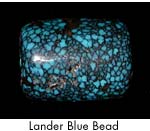
Marvin Syme ended up owning a number of turquoise mines in Nevada and later retired to Idaho. Hank Dorian operated the Nevada Club in Battle Mountain for a number of years until his passing and Bob and Dixie Johnson continued to sell Lander Blue turquoise until it ran out.The Lander Blue mine later became part of 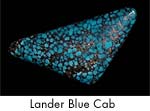 Dowell Ward’s large string of mines (now belonging to Mrs. Ward). Dowell Ward’s large string of mines (now belonging to Mrs. Ward).
Today, because of its rarity and value, there
seems to be more Lander Blue for sale than was
ever mined. With very little provenance available
when buying beautiful Lander Blue, this material
has truly become a case of ”Buyer Beware.”
 back to top
LONE MOUNTAIN
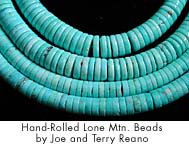 The
Lone Mountain turquoise mine is located in Esmeralda
County, Nevada, not far from Tonopah. It has
been one of the great producers of Nevada turquoise.
The color ranges from a beautiful clear blue
to a dark blue spider web. Lone Mountain has
always been noted for holding its color. To
this day jewelry can be found that was made
in the 1930’s or 1940’s with Lone
Mountain turquoise just as blue as when it was
made. The
Lone Mountain turquoise mine is located in Esmeralda
County, Nevada, not far from Tonopah. It has
been one of the great producers of Nevada turquoise.
The color ranges from a beautiful clear blue
to a dark blue spider web. Lone Mountain has
always been noted for holding its color. To
this day jewelry can be found that was made
in the 1930’s or 1940’s with Lone
Mountain turquoise just as blue as when it was
made.
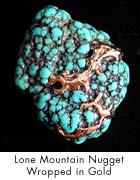 The
mine was claimed by Lee Hand in 1920 first as
the Blue Jay Mining Lode and later, after seeing
that so many mines had been named Blue Jay,
Hand changed the mine’s name to Lone Mountain.
In 1927 at a depth of about 40 feet Bert Kopenhaver,
who had leased the mine from Hand, found the
beautiful spider web turquoise material that
made Lone Mountain one of the top mines in the
Southwest. Today, Lone Mountain’s beautiful
blue spider web still gives Lander Blue, the
most valuable turquoise in the world, a run
for its money. The mine has continued to change
hands over the years and even now a small amount
of good material is being produced. The
mine was claimed by Lee Hand in 1920 first as
the Blue Jay Mining Lode and later, after seeing
that so many mines had been named Blue Jay,
Hand changed the mine’s name to Lone Mountain.
In 1927 at a depth of about 40 feet Bert Kopenhaver,
who had leased the mine from Hand, found the
beautiful spider web turquoise material that
made Lone Mountain one of the top mines in the
Southwest. Today, Lone Mountain’s beautiful
blue spider web still gives Lander Blue, the
most valuable turquoise in the world, a run
for its money. The mine has continued to change
hands over the years and even now a small amount
of good material is being produced.
Another rare occurrence has been the "fossil
turquoise" found in this mine. Plant fossils
and sometimes seashells that have dissolved
away leaving only the cavities were filled with
turquoise deposits. Turquoise nuggets in moss
agate have also been found.
|